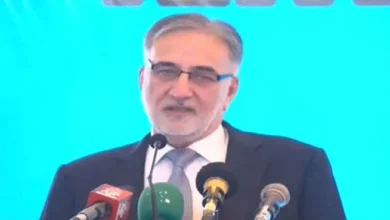
Shaukat Tarin Ferrets Out Flaws in PM Khan’s Economic Policies
The finance minister warned that the country would be on the verge of a collapse in four to five years if the growth rate did not reach at least 5%

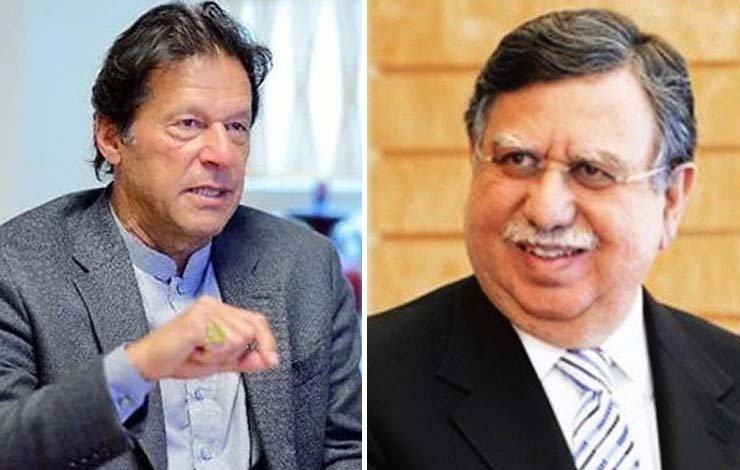
The succeeding Finance Minister Shaukat Tarin lashed out at the economic policies of Imran Khan’s government which the premier had started to extol months after he assumed office in 2018.
While talking in a meeting of the National Assembly Standing Committee on Finance on Monday, Shaukat Tarin slammed existing economic policies of the Imran Khan’s government and said the country did not have short, medium or long term policies in place.
He cited examples of China, India, and Turkey that have adhered to long-term economic policies.
Read Also
Japan Rolled Over $367m Debt Installment For Pakistan
He warned the country would be on the verge of a collapse in four to five years if the growth rate did not reach at least 5%.
Tarin also smashed the demand by International Monetary Fund (IMF) to hike power tariff over the next few years. The finance minister termed IMF’s demand as unjustified and said he would renegotiate with the global creditor.
He told the participants that the hike in the power tariff had stymied country’s progress and also increased corruption.
Tarin told the plan of providing targeted subsidies to the poor people is on cards. He also emphasized increasing the tax net instead of imposition of new taxes.
The minister also suggested that non-profitable public entities would be privatized.
IMF bailout package
IMF and Pakistan Tehreek-e-Insaf (PTI) government had agreed upon a $6 billion bailout package in July 2019 when Hafeez Shaikh was the advisor to Prime Minister on Finance and Revenue.
It was the 13th IMF program that Pakistan had availed.
The global lender had emphasized Pakistan to increase taxation to pay its external debt, equaling $37.359 billion then, within 39-month duration of the Extended Fund Facility (EFF) program.
In March 2021, IMF agreed to release a tranche of $500 million to Pakistan after the program remained halted for a year over the disagreement between IMF and Pakistan over certain matters.
The tranche was released on the condition of a sharp hike in power tariff, imposition of new taxes worth Rs 140 billion, and conversion of the State Bank of Pakistan (SBP) into an autonomous body.