


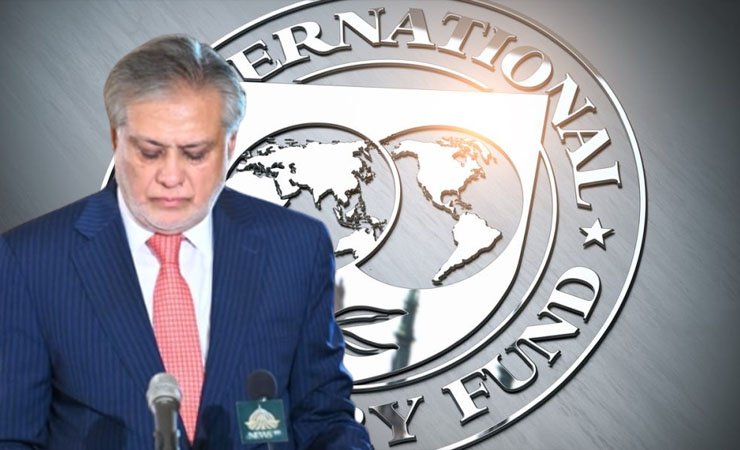
It has been 40 days since technical talks between government and International Monetary Fund (IMF) ended, but there is no sign of agreement on Staff Level Agreement.
An article in the English newspaper Business Recorder says that there is no prospect of a staff-level agreement between the government and the IMF.
In an article by Ali Khizr published in the Business Recorder, it has been said that 40 days have passed since the talks between the government and the IFF ended, but there are no signs of a staff level agreement.
The columnist wrote that the government itself seems to be pushing the country to the brink of collapse and is trying to scapegoat the IMF for its own failures.
3% increase in remittances from US in 8 months of current fiscal year
Ali Khizr said the government’s intentions are no longer so dire, as evidenced by the recent announcement of untargeted and price-distorting subsidies.
He wrote that the Prime Minister himself declared that the IMF deal could not be done in ten days, despite the fact that he and the Finance Minister were earlier claiming that the IMF deal would be done in 2-3 days. .
The article states that whispers are rife in Islamabad that the IMF is forcing Pakistan to compromise on its nuclear assets. On investigation, it appears that such discussions were initiated by the Finance Ministry.
As rumors swirled around the country, a coalition senator publicly demanded an explanation of the threats to strategic nuclear assets. A conspiracy theory seems to have been fueled, and the IMF later had to issue an explanation.
In another case, the Election Commission sent an explanation for the delay in the elections to the Finance Secretary stating that funds were not available to conduct the elections due to financial constraints imposed under the IMF program.
State Bank’s reserves increase by $280 million, reaches to $4.59 billion
In this regard, once again the IMF officials issued a statement denying all such claims that we have not talked about imposing any such restrictions. The government should stop selling these concepts.
The PDM (Pakistan Democratic Movement) government, particularly the Finance Ministry under Ishaq Dar, should be blamed for the failure to resume the IMF program despite the burden of inflation on the people.
Ali Khizr wrote that now almost all the conditions have been fulfilled. Energy prices have been raised, GST has been raised, new taxes have been imposed, currencies have been adjusted, and interest rates have risen. Still, the recovery of the program is far from us.
The columnist wrote that the government has failed to close the financing gap which was assured in the last review during Miftah Ismail’s tenure as finance minister.
At the time, Saudi and other GCC partners gave verbal assurances at an IMF board meeting that they would inject pledged deposits or provide some other form of funding.
He said that not having a staff-level agreement with the IMF could be an internal conflict in Pakistan that has nothing to do with the lenders, but that the conflict with the country’s most popular leader would help restore macroeconomic and political stability. can’t
Perhaps seeing this, the GCC countries shy away from investing in Pakistan’s economy. This is in line with the Saudi finance minister’s statement in Davos a few months ago, where he made it clear that the kingdom is changing the way it provides aid.
Moving away from direct grants and deposits provided unconditionally in the past. A way must be found to meet or meet the demands of Saudi foreign policy.