Pakistan reserves the right to defend itself, DG ISPR
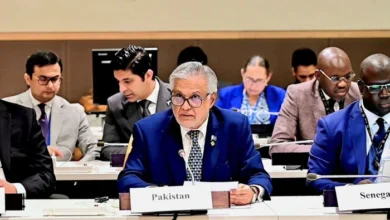
Pakistan, India NSAs made contact after missile attacks: Dar


Director General Inter-Services Public Relations (ISPR) Lt Gen Ahmed Sharif Chaudhry said on Wednesday that as per the latest tally, at least 31 innocent civilians were martyred and 57 others injured in the unprovoked Indian attacks on different cities of Pakistan and Azad Jammu and Kashmir (AJK).
He reiterated that Pakistan reserves the right to defend itself.
India launched strikes on Pakistan and AJK early Wednesday morning, an assault that Islamabad called a “blatant act of war” as tensions spiral between the nuclear-armed rivals after a deadly attack on tourists in Indian Illegally Occupied Jammu and Kashmir (IIOJK) last month.
Islamabad said six Pakistani locations, from mosques to hydropower projects, were targeted, with two dozen weapon impacts.
In retaliation and a befitting response, the Pakistan armed forces shot down five Indian Air Force (IAF) jets, seven drones, destroyed a brigade headquarters and a number of checkposts along the Line of Control (LoC).
Addressing a press conference today, the DG ISPR added that a major reason for the increase in casualties was India’s continued unprovoked firing on the LoC.
The strikes last night exposed India’s disgusting face, he said, adding: “Our enemy is so cowardly that instead of confronting our military forces head-on, it attacks unarmed civilians and populated areas in the darkness.”
He added that such actions highlight India’s desperation and its shift from supporting proxy elements to direct acts of aggression.
“When we made life difficult for terrorist proxies, India resorted to using its own military to carry out acts of terror,” he said. “Targeting innocent citizens and children — if that’s not terrorism, then what is?”
The DG ISPR questioned which terrorists were killed by targeting civilians and population centres.
Showing videos of civilians, including children, impacted by the Indian attacks, the military spokesperson questioned if these were the “terrorists” whom India claimed it was targeting on the night of May 6 and 7.
The military spokesperson added that the Neelum-Jhelum Hydropower project was also shelled by Indian forces.
Referring to Article 54 of the 1977 Additional Protocol 1 of the Geneva Conventions, the military’s spokesperson said that it was prohibited to attack, destroy, remove or render useless objects that were indispensable to the survival of the civilian population, such as drinking water supplies/installations and irrigation works.
Lt Gen Chaudhry said that the Pakistan armed forces responded with precision to Indian aggression by engaging only military targets.
“In self-defence, our forces struck only military targets. We did not resort to targeting innocent civilians like the cowardly enemy,” said Gen Chaudhry.
He confirmed that the Pakistan Air Force shot down five Indian fighter jets, including three Rafales, in what he termed as an exceptional air battle. “Such aerial combat is rarely witnessed — we are proud of our air force.”
He further said India’s violations along the LoC and ceasefire breaches have exposed its aggressive and destabilising role before the world.
“From launching unprovoked attacks on our borders to supporting terrorism through proxies, India has repeatedly shown its malicious intent,” he added.
DG ISPR, during the press briefing, affirmed that the protection of Pakistan’s people and territory is non-negotiable, saying that there would be no compromise on the safety of “our citizens or the sovereignty of our land”.
He reiterated Pakistan’s resolve to defend itself against any aggression. “Pakistan reserves the right to self-defence and will exercise it when necessary,” the military spokesperson affirmed.
He lauded the unity between the nation and its armed forces, stating, “Our forces are proud of the people, and the people have unwavering faith in their military. We are one against the enemy.”
Meanwhile Deputy Prime Minister and Foreign Minister Ishaq Dar said that national security advisers (NSAs) of Pakistan and India have spoken following New Delhi’s unprovoked missile strikes.
“There has been contact between the two, yes,” he told TRT World in response to a question whether the NSAs made contact after India’s overnight strikes against Pakistan.
India launched strikes on Pakistan and AJK early Wednesday morning — an assault that Islamabad called a “blatant act of war” — as tensions spiral between the nuclear-armed rivals after a deadly attack on tourists in Indian Illegally Occupied Jammu and Kashmir (IIOJK) last month.
Islamabad said six Pakistani locations, from mosques to hydropower projects, were targeted.
At least 31 civilians, including children, were martyred and 57 sustained injuries after India launched unprovoked and devious attack on Pakistan last night.
In retaliation, the Pakistan armed forces shot down five Indian Air Force (IAF) jets, seven drones, destroyed a brigade headquarters and a number of checkposts along the Line of Control (LoC).
Speaking to the TRT World, Dar said: “India has done something that is not condonable.”
“The country will decide when and what mode and which form we will react in future,” he added.
He said that Turkiye was the first country to issue a formal statement of condemnation over India’s aggression.
“This morning after the attack, which was almost past midnight, around 1am, the first call I received was from foreign minister of Turkiye,” said Dar.
Meanwhile, Turkish President Recep Tayyip Erdogan held a telephonic conversation with Pakistani Prime Minister Shehbaz Sharif and expressed Turkiye’s readiness to “do its utmost to prevent further escalation of tensions” between India and Pakistan.
Erdogan expressed Turkiye’s solidarity with Pakistan and extended his condolences to the martyrs, and prayed for the speedy recovery of the injured.
Declaring it “a very supportive statement”, Dar said Erdogan’s words showed Turkiye is like “a very close brother” to Pakistan.
One of the first ambassadors to reach out to him personally and through Pakistan’s Foreign Office following India’s strikes was the Turkish ambassador in Islamabad, Dar added.
“So you can evaluate our brotherhood, our friendship, and closeness,” he added.
The Turkish president expressed support for Pakistan’s “calm and measured approach” to resolve the crisis.
In a separate statement, the Turkish Foreign Ministry said the attack by India “created a risk of all-out war” and condemned its “provocative” steps and the targeting of civilians.
“We greatly value our friendship and brotherhood with Turkiye,” Dar added.
In addition to Türkiye, other countries and multilateral players like the United Nations have also called for an early resolution of the military dispute between the two countries.