


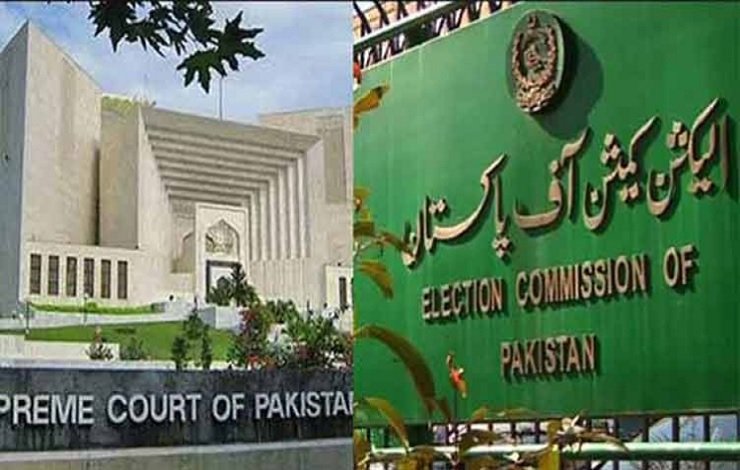
General elections will be held on February 11, the Election Commission of Pakistan (ECP) told the Supreme Court on Thursday.
The electoral body’s counsel, Sajeel Swati, said the process of drawing constituencies would be completed by Jan 29 paving the way for polls.
He made this revelation as the apex court resumed hearing a set of petitions calling for holding elections within 90 days after the dissolution of the National Assembly and the provincial legislatures.
A three-judge bench comprising Chief Justice of Pakistan (CJP) Qazi Faez Isa, Justice Amin-ud-Din Khan and Justice Athar Minallah took up the pleas moved by the Supreme Court Bar Association (SCBA), the PTI, Munir Ahmad and Ibad-ur-Rehman.
At the previous hearing, the court had issued notices to the Election Commission of Pakistan (ECP) and the federal government for their input on polls within 90 days.
The CJP had observed there were no two opinions that “all of us want elections, but a wrong impression is being created that we are not interested”.
The hearing
As the hearing resumed today, PPP lawyer Farooq H. Naek appeared in the apex court and requested to become a respondent in the case. He was given a green light from the judges after PTI’s Barrister Ali Zafar said he had no objections to the request.
Zafar then began presenting his arguments. At the outset, he contended that polls should be held within 90 days. However, CJP Isa said, “Your request for polls within 90 days has now become ineffective.”
The PTI lawyer insisted that his argument was connected with a fundamental right, to which Justice Isa asked if the former just wanted elections now. Zafar replied in the affirmative.
“Will anyone oppose it?” the chief justice asked. In his reply, the PTI counsel said no. The CJP then asked Attorney General for Pakistan Mansoor Usman Awan if he had any objections to polls, to which the latter also replied in the negative.
Continuing his arguments, Zafar said Articles 58 (Dissolution of the National Assembly) and 224 (Time of election and by-election) could be read. “Without elections, neither can the Parliament run nor can laws be formed,” he contended.
He went on to say that there was a difference between giving a schedule for elections and announcing the poll date, adding that giving the election date was also mentioned in the Constitution.
“The law ministry believes that the president cannot give a date for polls,” Zafar stated. He highlighted that as per the 90-day deadline, elections should be held on Nov 7.
It must be noted President Dr Arif Alvi had written a letter to Chief Election Commissioner (CEC) Sikandar Sultan Raja on September 13 wherein he proposed that elections be held by November 6.
However, the Ministry of Law and Justice had Alvi had later informed Alvi that the powers to announce the poll date rested with the ECP, not the president.
During the hearing today, Justice Minallah asked why it took the president so long to write the letter to the ECP. On the other hand, the chief justice noted that the text of the said letter was “vague”.
“Did the president approach us for an opinion [on the matter] from the Supreme Court?” CJP Isa asked, to which Zafar said this was not the case.
At one point, the top judge asked the PTI counsel if he was trying to say that the president did not fulfil his constitutional responsibility. “The assembly was dissolved on Aug 9 but the president wrote the letter in September,” he said.
Meanwhile, Justice Minallah said, “The command of the Constitution is very clear that the president had to give the date [for elections], there is no disagreement in it.”
“Whoever wants to disagree can continue doing so,” Justice Isa stated, warning that the court could take a judicial notice as well. He also said that the letter could not be written on the “last day”.
For his part, Zafar said that in his opinion the president had fulfilled the responsibility.
Here, Justice Minallah said there wouldn’t have been any objections if the president had given the election date on the day the National Assembly was dissolved.
“What do you want from us now? Do you want us to direct the president to give a date? The president says he took advice from so and so. Can this court now issue a writ against the President?” CJP Isa asked.
He pointed out that machinery was involved in conducting polls. “Can the Supreme Court give the date for elections?” the chief justice asked.
Justice Minallah said that Article 98 of the Constitution was very clear on the court’s role in the matter. The said law pertains to the conferring of functions on subordinate authorities.
“Did the ECP ever say that the president should give the election date?” the judge further asked.
Zafar replied that the electoral body had said that the authority to give the poll date lay with the ECP. He added that there was a need to look at the SC’s role in the matter.
“Can we go against the president and give a date for polls ourselves?” Justice Isa asked, highlighting that the Constitution gives the apex court the authority to do so.
The PTI counsel said such an action had been taken before but Justice Minallah noted that the question currently under discussion was different.
The CJP said that holding elections was good and “not a problem”. Addressing the PTI lawyer, the chief justice said: “Your leader is also the leader of the president. Why wasn’t the president told to announce a date for elections?”
At one point during the hearing, Justice Khan said that Zafar’s argument actually was that the president had deviated from the Constitution.
“Prima facie the president, ECP and government are all responsible,” Justice Minallah said. “The question now is what will be the result of this,” he noted, adding that elections must be held on time.
The petitions
SCBA chief Abid Zuberi, through his petition, had pleaded with the apex court to suspend the operation of a decision taken by the Council of Common Interests (CCI) on Aug 5 since the body did not meet the legal requirement of proper composition when it met that day.
He said the ECP’s primary responsibility was to hold elections within 90 days from the date of dissolution of the assemblies — a mandatory period which cannot be extended on any ground, including delimitation of constituencies.
Meanwhile, the PTI’s application sought direction from President Dr Arif Alvi to announce a date for holding elections within 90 days of the dissolution of the National Assembly.
It also requested the apex court to order the ECP to issue a schedule accordingly, besides the governors of all four provinces be directed to announce the date of elections within 90 days of the dissolution of the respective assemblies, or in accordance with the SC judgement in the Punjab Assembly election case.
Election delay
The Election Commission of Pakistan (ECP) had earlier ruled out polls this year citing the need for fresh delimitation of constituencies.
Since the National Assembly was dissolved three days before the end of its constitutional term, Article 224 of the Constitution mandates that elections be held within 90 days of the dissolution of the assembly by November 7.
But at the same time, Section 17(2) of the Elections Act states that “the commission shall delimit constituencies after every census is officially published.”
Last month, the commission announced that elections would be held in January 2024 but stopped short of announcing a date.
The decision has garnered mixed reactions from political parties. The JUI-F has opposed the timing of polls due to “weather conditions”, while the PML-N threw weight behind the ECP.
The PPP and PTI, on the other hand, have called for the immediate announcement of the election date and assurance of a level playing field. Meanwhile, the caretaker government has expressed hope that the date for elections would be announced soon.