


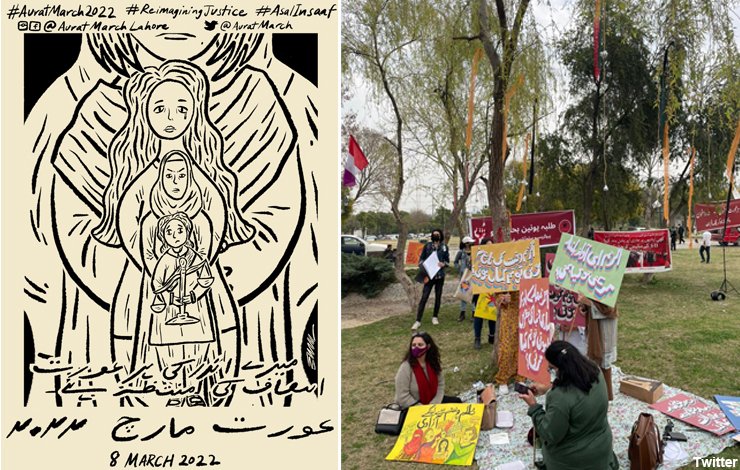
International Women’s Day is being observed across Pakistan which will be marked by several events of Aurat March in different cities including the provincial and federal capitals Islamabad, Karachi, Lahore and others.
Aurat [women] marches in the country draw attention in the country every year with a lot of controversies besides the continuation of a debate in its favour and opposition.
The Aurat March organisers had earlier moved to the Islamabad High Court (IHC) for not getting permission to hold the event in the federal capital by the local administration this year.
Aurat March 2022: Mahwash Ajaz presents understandable ‘manifesto for women rights’ in Pakistan
On the other hand, Federal Minister for Religious Affairs and Interfaith Noorul Haq Qadri had earlier suggested observing the International Women’s Day as a Hijab Day in opposition to the Aurat March.
The country’s first event of Aurat March had been organised in 2018.
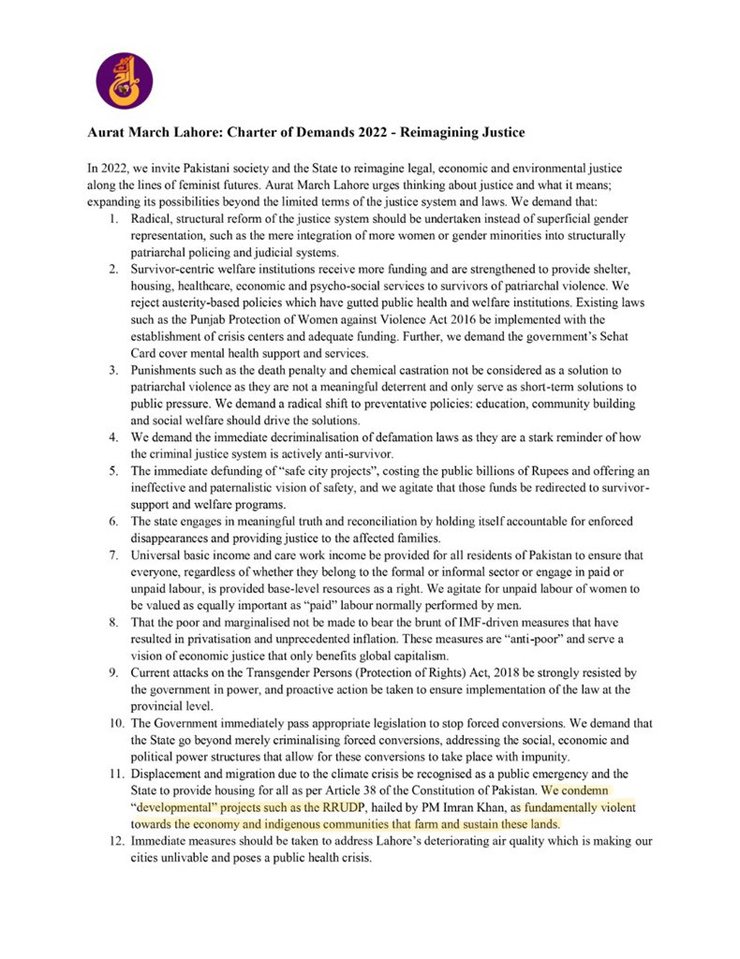
Reimagining Justice: Aurat March 2022’s Charter of Demands

📢🔔
Aurat March Lahore is proud to announce its Manifesto for 2022 centering on the theme of #ReimaginingJustice.Link to Manifesto: https://t.co/dPUNZtOTBJ.
Tweet using the hashtag #AsalInsaaf, about what insaaf means to you.#AuratMarch2022 pic.twitter.com/Xy6SIDX3s1
— عورت مارچ لاہور – Aurat March Lahore (@AuratMarch) February 18, 2022
History
In 1908, 15,000 American woman had taken to streets of New York for demanding their right to vote, better salaries and a reduction in the job timings.
The movement to observe a special day for women’s was introduced on February 28, 1909, on the occasion of US Women’s Day by the Socialist Party of the America which later spread to across the United States (US). The International Women’s Day was then observed on February 28 every year since 1913.
In August 1910, an International Socialist Women’s Conference was organized ahead of the general meeting of the Socialist Second International in Copenhagen, Denmark.
Inspired in part by the American socialists, German delegates Clara Zetkin, Käte Duncker, Paula Thiede, and others proposed the establishment of an annual “Women’s Day”, although no date was specified.
The 100 delegates, representing 17 countries, agreed with the idea as a strategy to promote equal rights, including women’s suffrage.
The following year, on March 19, 1911, the first International Women’s Day was marked by over a million people in Austria, Denmark, Germany, and Switzerland.
In Austria-Hungary alone, there were 300 demonstrations,[16] with women parading on the Ringstrasse in Vienna, carrying banners honouring the martyrs of the Paris Commune.
Across Europe, women demanded the right to vote and to hold public office, and protested against employment sex discrimination.
IWD initially had no set date, though it was generally celebrated in late February or early March. Americans continued to observe “National Women’s Day” on the last Sunday in February, while Russia observed International Women’s Day for the first time in 1913, on the last Saturday in February (albeit based on the Julian calendar, as in the Gregorian calendar, the date was March 8).
In 1914, International Women’s Day was held on March 8 for the first time in Germany, possibly because that date was a Sunday.
As elsewhere, Germany’s observance was dedicated to women’s right to vote, which German women did not win until 1918.
Concurrently, there was a march in London in support of women’s suffrage, during which Sylvia Pankhurst was arrested in front of Charing Cross station on her way to speak in Trafalgar Square.
In the 1970s and 1980s, women’s groups were joined by leftists and labor organizations in calling for equal pay, equal economic opportunity, equal legal rights, reproductive rights, subsidized child care, and the prevention of violence against women.
The United Nations began celebrating International Women’s Day in 1975, which had been proclaimed the International Women’s Year.
In 1977, the United Nations General Assembly invited member states to proclaim March 8 as an official UN holiday for women’s rights and world peace.
It has since been commemorated annually by the UN and much of the world, with each year’s observance centered on a particular theme or issue within women’s rights.