


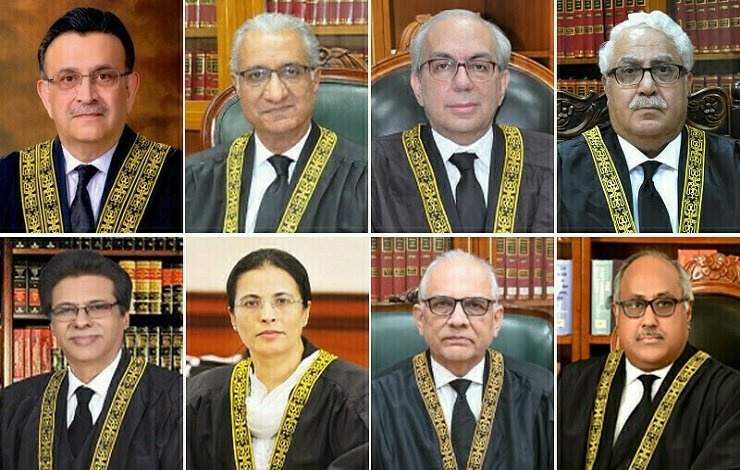
Hearing on the petitions filed against the Supreme Court Practice and Procedure Act, 2023 has been adjourned till Monday. Chief Justice Umar Ata Bandial has remarked that the court expects a serious discussion by the parties in the case.
A hearing was held in the Supreme Court of Pakistan on the petitions filed against the Supreme Court Practice and Procedure Act 2023. An 8-member bench headed by Chief Justice Umar Ata Bandial heard the case.
The Supreme Court of Pakistan heard the Supreme Court Practice and Procedure Act, 2023, under which the powers of the Chief Justice were limited under a law passed jointly by Parliament.
An 8-member bench headed by Chief Justice of Pakistan (CJP) Umar Atta Bandial, Justice Ijaz-ul-Ahsan, Justice Muneeb Akhtar, Justice Mazahir Naqvi, Justice Muhammad Ali Mazhar, Justice Ayesha Malik, Justice Hasan Azhar Rizvi and Justice Shahid Waheed heard the case. Heard the
A larger bench heard constitutional petitions filed against the Supreme Court Practice and Procedure Act, 2023. Three important points emerged during today’s hearing.
- During the hearing, the Supreme Court rejected Attorney General of Pakistan Mansoor Usman Awan’s plea to lift the court’s injunction against the Practice and Procedure Act, 2023.
- During the hearing, the Attorney General of Pakistan and the Pakistan Bar Council requested to constitute a full court in the present case, which was rejected by the Supreme Court.
- It was also remarked during the hearing that the legislation passed under the Practice and Procedure Bill 2023 to limit the powers of the Supreme Court has changed the basic structure of the Constitution.
Chief Justice Umar Ata Bandial remarked that the court will not accept any plea regarding which judge should or should not be included in the panel. Because a larger bench cannot be constituted on a personal whim. Because we understand that a big campaign is being run against the judges of the Supreme Court.
The Chief Justice remarked that such an environment has been created in which all the judges have been made controversial. Objections are being raised against all the judges.
Chief Justice Umar Ata Bandial further remarked that never in the history of Pakistan has the basic structure of the constitution been changed. There are also some limitations to the federal list of legislative powers.
The Supreme Court has also summoned all the records of the Parliament at the time of passing the Practice and Procedure Bill, 2023. Section 55 of the Supreme Court Federal Legislation will also be reviewed in detail.
The Supreme Court has also sought the details of the proceedings of the Standing Committees regarding the Practice and Procedure Bill 2023.
The Pakistan Bar Council (PBC) counsel argued that the council has always fought for the rule of law and the judiciary. He suggested that it would be appropriate to set up a full court to hear the case, comprising a bench of seven senior-most judges to whom no one had any objection.
Chief Justice Umar Atta Bandial said that a judge cannot be stopped from working until the Supreme Judicial Council (SJC) gives its opinion, and cited the same judgment during the proceedings against Justice Qazi Faiz Isa.
Petitions against Practice and Procedure Bill 2023
The three petitions against the Practice and Procedure Bill 2023 have been filed under Article 184(3) of the Constitution by Advocate Muhammad Shafi Munir, Raja Aamir Khan, Chaudhry Ghulam Hussain and others.
It has been argued by the petitioners that the Bill was enacted on the ground of malice, hence it should be struck down immediately.
Apart from the federal government, the law secretary, the principal secretaries of the prime minister and the president have been named as defendants in the case. The petitioners have requested the court to suspend the bill during the pendency of the petition, directing President Alvi not to assent to the bill so that it does not become an Act of Parliament.
According to the petitions, the federal government cannot enact any law that would limit the functioning of the Supreme Court or the powers of its judges, including the Chief Justice of Pakistan (CJP), under the Constitution.