


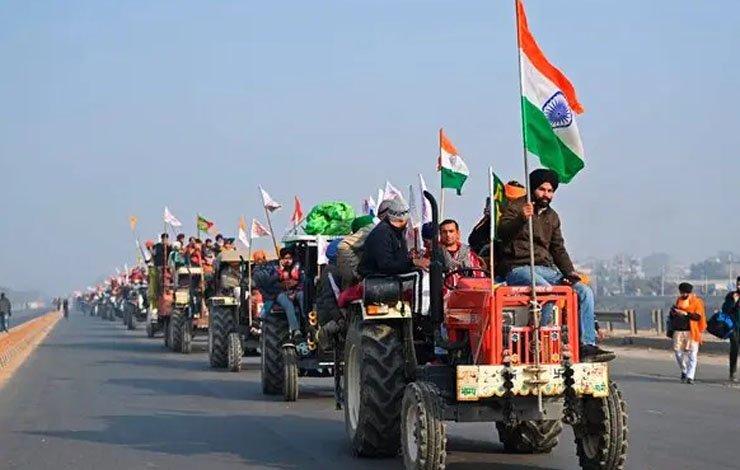
With uncontrollable ongoing protests by thousands of farmers mainly from Punjab and Haryana on roads, barriers, iron nails, rods, makeshift walls, and injured police officers, India right now seems moving towards the dangerous path of destabilization.
In a bid to repeal the new agricultural reforms, farmers mostly from Haryana and Punjab, have been demonstrating on roads for the last three months.
A massive clash between the demonstrating farmers and the police force that resulted in the injury of many police officers posed a threat to the Modi government in India.
However, it is the need of the hour to comprehend the rationale behind the farmer’s protest.
A recent thread posted on Twitter shared few excerpts from the author Amandeep Sandhu’s book “Panjab: Journeys Through Fault Lines” as he strived to explain the ongoing chaos in India.
Punjab has been considered as the breadbasket of India with a contribution of around 40% of wheat and 30% rice.
With a large number of farming families in Punjab, the average income of a family is nearly INR 3,500 as per the Economic Survey Report in 2016.
Meanwhile, among the 1.85 million farming families in Punjab, around 65% of them are small scale farmers living barely with poor means of survival due to the division of lands by Inheritance Laws.
However, more than 1,850 procurement centers were established in Punjab but the grains markets or mandis stayed ineffectual in managing the supply chain.
The region of Punjab has long been facing unjust treatment as compared to central India.
Despite several sanctions announced including 2007’s Rehabilitation Package for southern states, Special Package for Vidarbha, Dry Land package for water-deficient areas, Punjab remained forlorn. Not only financial aid, but the state of Punjab has also been deprived in terms of water supply as well.
Read Also
Rihanna, Greta Join Bandwagon To Support Farmers in India
Among all other states, Punjab is the exception with the rivers under the control of the federal government.
The state has been deprived to receive water from the river Jamuna claimed to be non-riparian to it, however, the rest of the states have been availing the water despite being non-riparian.
Concertina wires & trenches around farmer protests have shocked everyone but the sight is far too familiar for us Kashmiris. Kashmir has been under the worst form of siege since August 2019. The scale of suppression here is unimaginable.
— Mehbooba Mufti (@MehboobaMufti) February 3, 2021
The average annual income of a farming family in more than half of India is INR.20,000.
With the recent agricultural reforms, the Bharatiya Janata Party (BJP) has enforced the laws that seem not propitious for the poor farmers that have been estimated to be around 85% in the country.
The new reforms are allowing big companies to directly deal with the farmers and hence, allowing them to exploit.
Farmers are concerned about the eradication of wholesale markets and assured prices in case of a bad crop year which would leave them insignificant.
Strong objections have been raised by the farmers from Punjab and Haryana that the reforms can eradicate farming and eventually the farmers in India.